


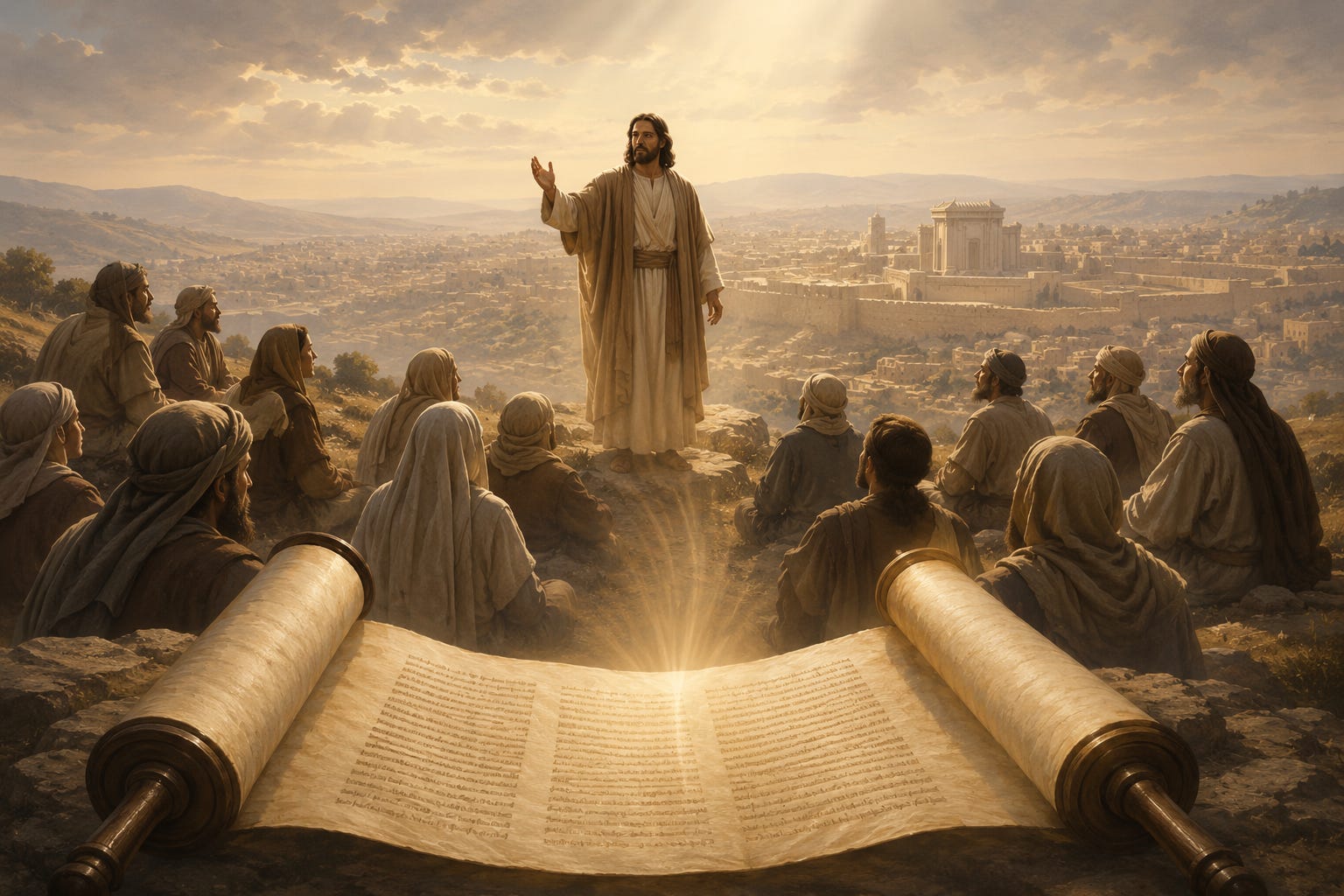
“Do not think that I have come to abolish the Law or the Prophets; I have not come to abolish them but to fulfill them. For truly, I say to you, until heaven and earth pass away, not an iota, not a dot, will pass from the Law until all is accomplished. Therefore whoever relaxes one of the least of these commandments and teaches others to do the same will be called least in the kingdom of heaven, but whoever does them and teaches them will be called great in the kingdom of heaven. For I tell you, unless your righteousness exceeds that of the scribes and Pharisees, you will never enter the kingdom of heaven.” (Matthew 5:17-20)
These words of our Lord are some of the most difficult and misunderstood in all of Scripture. I once had a professor claim, on the basis of these verses, that we are to follow all the Old Testament laws which are not explicitly repealed in the New Testament. I nearly raised my hand to ask if his suit coat today was made of two different kinds of fabric, but I decided to bite my tongue. In all seriousness, though, this surely cannot be a correct interpretation. For one thing, that sort of Christianity would look far more like orthodox Judaism than Christianity. For another, what are we to do with the broader scope of the New Testament? How are we, for example, to deal with “In speaking of a new covenant, he makes the first one obsolete.” (Hebrews 8:13)? Or what about Paul’s statements, particularly from Romans and Galatians? “We know that a person is not justified by works of the law but through faith in Jesus Christ” (Galatians 2:16) and “you are not under law but under grace” (Romans 6:14) are just two of many examples. As Christians, we certainly affirm that Jesus and Paul did not disagree on this issue. But how then do we square the above teaching of Christ with the letters of Paul and the Hebrews writer?
Given the controversial nature of this passage, I think it would do us good to decide what it doesn’t mean before focusing on what it does. The way I see it, there are three questions that need to be answered by any adequate interpretation of Matthew 5:17-20.
1. What does it mean to “fulfill”?
2. To what does “until all is accomplished?” refer?
3. What are “these commandments”?
As for the first question, the Greek word that Matthew uses for “fulfill” means “to complete, fill, fulfill.” Of course this particular instance of the word should be translated “fulfill” rather than “complete” or “fill”, but this doesn’t get us very far. What does Matthew mean by “fulfill”? Matthew uses this word 16 times in his gospel, including this particular instance. 2 times it clearly means “to fill (up)”. 12 times it refers to the fulfilling of prophecy. Only one time is this word translated “fulfill” when not in the case of prophecy fulfillment, and this is when Jesus tells John that his baptism is fitting to “fulfill all righteousness.” I think it can be safely said that the occurrence of the word translated “fulfill” in Matthew 5:17 can be grouped with the prophecy fulfillment passages in Matthew. So now we must ask what it means to fulfill a prophecy. In short, it means that it has been brought to completion, the prediction has come to pass, and we no longer wait for the prediction to come true - it already has. If we input a similar definition into Matthew 5:17, we see that what Jesus is saying is that the entire Law and prophets find their culmination in Him. They are complete, and rather than having to complete them ourselves, we look to the one who fulfilled them. Matthew’s use of “fulfill” certainly sheds some light on Jesus’ statement here.
As for the second question, the phrase “all is accomplished” is not so easy to understand. It seems to me as though it could mean two things: until the end of the world, or until the crucifixion and resurrection of Christ. However, I think we can do better than pure guesswork. The word Matthew uses for “accomplished” is ginomai. Matthew uses the word many times throughout his gospel, as it is a very common word, but one time stands out and is helpful here. In Matthew 27:54, Matthew writes, “When the centurion and those who were with him, keeping watch over Jesus, saw the earthquake and what took place (ginomai), they were filled with awe and said, ‘Truly this was the Son of God!’” Given the fact that Matthew uses this term liberally throughout his gospel, this is not a proof that ginomai (“accomplished”) in Matthew 5:18 refers to the crucifixion. However, when combined with Matthew’s account of the temple curtain being torn in two, which suggests a change in covenants, it does make it very likely that Matthew 5:18 refers to the crucifixion.
However, the third question is crucial: what does Jesus mean by “these commandments” when he says that whoever relaxes one of the least of them will be least in the kingdom? While I don’t want to make this a grammar lesson (which I am unqualified to give and which no one wants anyway), I do happen to know that the demonstrative pronoun “these” which Jesus uses implies close proximity. Thus, the more natural interpretation of “these commandments” refers to the commandments which Jesus is about to give in his sermon, not the entirety of the Law. This interpretation also makes more sense in light of his following statement, “For I tell you, unless your righteousness exceeds that of the scribes and Pharisees, you will never enter the kingdom of heaven.” He is about to show them what a “righteousness that exceeds” looks like, in his statements, “You have heard that it was said… but I say to you…”. It seems as though “these commandments” refers to his commandments in the sermon.
It is unfortunate that we must spend so much time talking about what this verse doesn’t mean before we talk about what it does mean, because what it does mean is powerful. It means, firstly, that Jesus the the culmination of the entire Old Testament. It’s hard to truly explain how electrifying this claim would have been for Jesus’ Jewish audience. He has just said that all their Scriptures, the entire Law and all the Prophets, are brought to completion in his person. Thus, when he is crucified, “it is finished,” or perhaps, “all is accomplished.”
Secondly, these words of Christ mean that Christ fulfilled the Law so we don’t have to. Christ is the one person to ever follow the Law perfectly. Through Adam’s sin, death came into the world, but through Christ’s righteousness, we are made righteous by our faith in him. As Paul says, “For as by the one man’s disobedience the many were made sinners, so by the one man’s obedience the many will be made righteous.” (Romans 5:19). It is because of this that we are now justified by faith apart from works of the Law. Through our faith, we fulfill the Law (Romans 3:31), because Christ’s perfect fulfillment is imputed to us.
Thirdly, it means that obedience is a matter of the heart. Again, Jesus goes on to expound upon how our righteousness must exceed that of the scribes and Pharisees. In his “you have heard that it was said…” statements, he takes commands and makes the Law a matter of the heart. For instance, he says that they have heard it said, “Do not murder,” but that he says to them that whoever hates his brother in his heart is guilty. The scribes and Pharisees were quite good at keeping the letter of the Law. Their attitude, however, is evident from Jesus’ statement about them in Matthew 23:23 - “Woe to you, scribes and Pharisees, hypocrites! For you tithe mint and dill and cumin, and have neglected the weightier matters of the law: justice and mercy and faithfulness. These you ought to have done, without neglecting the others. You blind guides, straining out a gnat and swallowing a camel!” The picture Jesus paints here is of the Pharisees counting out mint and dill and cumin, tiny herbs, to make sure that they get exactly a tenth, while ignoring the matters of the heart: justice, mercy, and faithfulness. They were getting the smaller parts of the law (the gnats) correct, while paying no attention to the more important parts (the camels, the matters of the heart). Perhaps it is for this reason that Jesus quotes Isaiah the prophet, who says, “This people honors me with their lips, but their heart is far from me.” How often do we get caught up in “going through the motions” and forget to truly follow the greatest commands in our daily walk: love God, and love your neighbor? May we never be so convinced that we are “getting it right” because we go to church three times a week that we forget to be people of love, mercy, patience, and kindness.
To God be the glory, who sent His Son to be the perfect fulfillment of the Law on our behalf, so that through faith in Him we are counted righteous! May we always be people who follow the commands of Jesus and love the Lord our God with all our heart, soul, mind, and strength, and our neighbor as ourselves.
